The High Cost of a Frictionless Life

Most people think of silence as an absence—a vacuum where noise used to be. But the silence in the heart of the Coromandel isn't empty.
It is dense. It is a physical presence that has a texture, a temperature, and a weight.
In the city, silence is usually just dead air trapped between concrete walls, a hollow space waiting to be filled by the next notification. But when you turn inland toward the Green Wall and move into the 22 acres of Onetai, the silence starts to hum.
It is the sound of a forest breathing. As you walk the legacy trails, you are surrounded by the collective pulse of ancient kauri, the rhythmic swaying of ponga fronds, and the distant, silver thread of running water.
This isn't a quiet that demands you lower your voice; it is a quiet that invites you to listen to the world again. It is a stillness that has seen centuries of mornings exactly like this one, providing a sense of scale that makes modern anxieties feel remarkably small.
We have become used to living in low-resolution. We move through sterile, climate-controlled spaces designed to be frictionless and, ultimately, forgotten. The human spirit wasn't built for the beige of the modern office or the flat, flicker-rate light of a screen.
We were built for high-resolution living—for landscapes that demand our attention and air that carries the scent of the living earth.
True luxury is the return of this color to your day, a restoration of the vividness we often trade for convenience.
At Onetai, that resolution begins with the light. Because we are nestled against the vertical spine of the ranges, the sun doesn’t just rise; it arrives. It shifts from a pale, misty silver at dawn to a heavy, liquid gold by late afternoon, moving across the valley floor like a slow-motion clock.
It is the deep, fractal green of the native bush that allows your eyes to finally stop scanning for data and start resting in depth.
Looking at these complex natural patterns actually reduces heart rate; it is the visual equivalent of a deep breath.
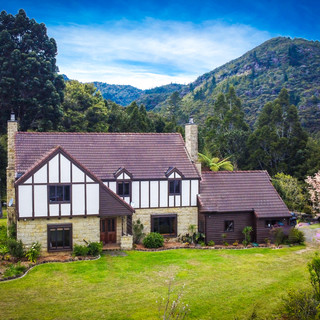
The experience inside the lodge is designed to get out of the way of this landscape. We have curated the space to be a landing pad for the senses, where the architecture acts as a frame rather than a distraction.
The rituals here are simple but profound: the morning coffee enjoyed on the deck as the valley mist clears, the exploration of orchard fruit gathered while the dew is still on the grass, and the walk toward the private waterfall where the air is noticeably cooler and more oxygen-rich.
As evening settles, a second transition occurs. The Green Wall catches the final rays of the sun, casting long, protective shadows over the estate. This is when the Spirit of the land is most palpable.
The transition into night isn't abrupt; it is a soft fading into the ceremony of the glowworms that line the drive. Without the light pollution of the coast or the city, the stars here feel closer, more intimate, as if the valley has been carved out specifically to hold the night sky.
The coast is a beautiful place to visit—a place of salt and horizon—but the valley is where you come to be restored.
There is a specific point on the 20-minute drive inland where the air changes. The salt spray of the coast is replaced by the mineral, grounding scent of the interior. It’s the feeling of crossing a threshold into a world that is more permanent and more real than the one you left behind.
It is a choice to stop skimming the surface of the peninsula and start inhabiting the volume of the land. It is the return to the vividness of being alive.
It is the valley in high-definition.


Comments